
Keeping up his tradition of celebrating the festival with soldiers, Prime Minister Narendra Modi visited Sir Creek near the Indo-Pak border in Gujarat's Kutch district and offered sweets to jawans.

A thick layer of fog was seen in several parts of the city, weather officials said.

The Taj Mahal in Agra was engulfed in a layer of haze on Monday morning amid the rise in air pollution levels, with tourists unable to believe their eyes.

Firecracker bursting till late Sunday night led to a spike in pollution levels amid low temperatures.

Six weather stations across Delhi recorded over 100 mm of rain in a single day, the India meteorological department (IMD) said on Thursday, categorising it as an "extremely intense spell".

Squandering the relief due to rain, Delhi recorded a jump in pollution levels and a smoky haze returned on Monday after people flouted the ban on firecrackers on Diwali night.

According to the Graded Response Action Plan (GRAP), the air quality is considered to be in the emergency category if the PM2.5 and PM10 levels continue to be above 300 micrograms per cubic metre and 500 micrograms per cubic metre respectively for 48 hours or more.

Breathing polluted air for long periods of time can cause more serious problems. Avoid exercising outdoors on bad air days, suggests Dr Varun Gupta.

The maximum temperature on Saturday settled at 18.1 degrees Celsius, two notches below the season's average, and the minimum was recorded at 3.6 degrees Celsius, four notches below the season's average, the IMD said.

This time, Delhi saw a sharp improvement in air quality just ahead of Diwali which can be attributed to intermittent rainfall on Friday and wind speed favourable for the dispersion of pollutants.
Delhi's 24-hour average air quality index (AQI) stood at 248 on Saturday.
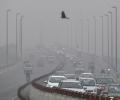
With Delhi recording air pollution levels seven to eight times above safe standards on Monday, the city government announced the return of its flagship odd-even scheme after four years anticipating further deterioration of air quality post-Diwali.

The Bandra Kurla Complex area of Mumbai recorded an AQI of 300 and in the Chembur area, AQI of 319 was recorded as 'very poor'.

The poisonous haze has been causing significant problems for people with existing respiratory issues, according to doctors.
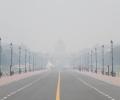
The city's average air quality index (AQI) stood at 220 at 12 noon, improving from 263 at 4 pm on Monday.

The ICC says it is monitoring the air quality in smog-shrouded New Delhi ahead of the World Cup match between Bangladesh and Sri Lanka on Monday.

Pollution levels in the national capital entered the "severe" zone for the first time this season on Thursday, with scientists warning of a further spike over the next two weeks.

Delhiites woke up on Thursday to a thick envelope of smog as air quality in the national capital and in adjoining regions, dipped into severe category again.

The rains could lead to a rise in the water levels of the Yamuna, which has been flowing above the danger mark of 205.33 metres for days now.

Areas in the National Capital Region -- Noida and Gurugram -- recorded an AQI of 529 and 478 respectively both in the highly toxic 'severe'.

An improvement in the wind speed November 21 onwards might bring air pollution levels down.

The city's 24-hour average AQI was recorded in the 'poor' category at 265 on Saturday as residents flouted the ban on firecrackers in parts of the national capital ahead of Diwali, according to Central Pollution Control Board's (CPCB) data.
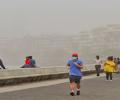
'Till such time climatic activities resume up north in the plains and the hills, Mumbai's air quality may not improve.'
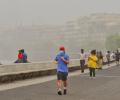
La Nina, construction worsen air quality; spike in respiratory ailments.

IMAGES from the ICC World Cup match played between Bangladesh and Sri Lanka, in New Delhi, on Monday.

After churning across the Arabian Sea for more than 10 days, Biparjoy made landfall near Jakhau Port in Gujarat on Thursday.

After Bangladesh, Sri Lanka were forced to cancel their opening training session in the national capital on Saturday due to "severe" air pollution.
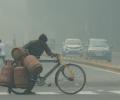
'These measures should be in place throughout the year in order to bring down AQI levels to 100 or below'
Acentral panel directed authorities to ban the plying of 4-wheeled diesel LMVs in Delhi and adjoining NCR districts and the entry of trucks into the capital.

During a hearing on Friday, the bench noted that Mumbai was witnessing a decline in the bursting of firecrackers.

The city recorded a minimum temperature of 14.6 degrees Celsius, a notch above normal, according to the India Meteorological Department.
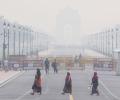
The capital witnessed a clear morning on Friday with the minimum temperature settling a notch below normal at 14.6 degrees Celsius.

Welcoming the reduction in pollution, environmentalists urged the government to treat it as a "wake-up call" and stop its "obsession" with "development" at the cost of the environment.
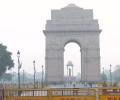
According to forecasting agencies, the city is set to record its best air quality for the day after Diwali since 2015 on Tuesday.
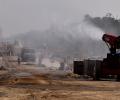
Officials at the India Meteorological Department said winds gusting up to 20 kmph on Sunday and 25 kmph on Monday led to a marked improvement in the air quality and improved visibility.

The eastern and northern parts of Delhi witnessed rain and hailstorm, IMD said.

The minimum temperature in the national capital on Saturday settled at 10.2 degrees Celsius, three notches above the season's average, it said.

Health expert termed the problems caused due to the rise in pollution as a "medical emergency".
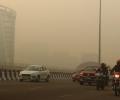
Authorities on Friday had advised people to limit outdoor activities and told government and private offices to cut vehicle use by at least 30 per cent as air quality in Delhi-NCR inched towards the emergency level amid a rise in emissions from farm fires and unfavourable meteorological conditions.
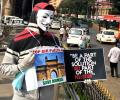
Don't ignore symptoms like coughing, wheezing or shortness of breath, warns Dr Sandeep Tilve.
 © 2026 Rediff.com - Investor Information - Advertise with us - Disclaimer - Privacy Policy - Sitemap - Feedback - About us - Terms of use - Grievances